
Ukraine Develops Mid-Range Strike Drones to Counter Russian Lancet Threat
Domestic UAV systems evolve into precision tools targeting air defences and critical assets
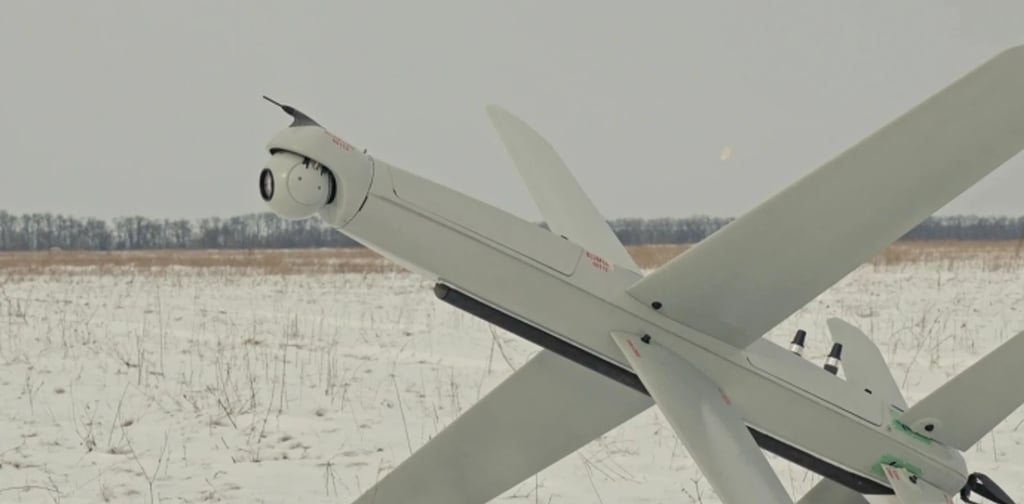
Russian Lancet loitering munitions have become a persistent feature of the battlefield, placing continuous pressure on Ukrainian forces through mid-range strike capability (середньодальня ударна спроможність) and highly visible real-time strike footage (відео удару в реальному часі). These drones, recognizable for their X-shaped design, operate at distances of tens of kilometres and have been widely used against artillery, radars, and logistical infrastructure.
From the early stages of the war, the Lancet gained prominence due to its ability to combine reconnaissance and strike functions. Paired with relay drones, it enables extended operational range (розширений операційний радіус) and precise targeting deep behind enemy lines. Russian sources claim thousands of such strikes, reflecting the drone’s role in both military operations and information warfare narratives (наративи інформаційної війни).
Ukraine initially lacked comparable systems. Early reliance was placed on foreign-supplied loitering munitions, including Switchblade and Warmate drones, which provided limited capabilities due to small warhead capacity (мала потужність бойової частини) and restricted supply volumes. These constraints highlighted the need for a domestically developed solution capable of operating under electronic warfare conditions (умови радіоелектронної боротьби).
Developing such systems proved complex. Ukrainian engineers faced challenges in ensuring communication stability under jamming (стабільність зв’язку під час глушіння) and designing drones capable of maintaining control at low altitudes where signal loss is more likely. Additional requirements included integrating relay functions and enabling autonomous navigation to sustain operations despite disruptions.
Over time, Ukraine’s defence industry produced several equivalents, including Bulava, RAM-2X, Perun, and other systems. These drones now form part of a broader mid-range drone campaign (кампанія середньодальніх дронів) aimed at targeting air defence systems and critical infrastructure behind enemy lines. Early prototypes were introduced in 2024, with wider deployment beginning toward the end of 2025.
Technological improvements have expanded their effectiveness. Newer variants incorporate autonomous navigation modules (модулі автономної навігації) and machine-vision-based targeting systems, reducing dependence on continuous operator control. The integration of satellite communication tools has further enhanced signal resilience (стійкість сигналу) during long-range missions.
Operational range has also increased significantly. While earlier models could strike targets up to 50 kilometres away, updated versions now reach distances exceeding 100 kilometres. In one reported case, a Ukrainian unit successfully targeted an air defence system located more than 120 kilometres from the front line, demonstrating advances in long-range precision strike capability (далекобійна точна ударна спроможність).
Military units describe these drones as precision instruments. One commander noted, "These drones are, in essence, a surgical instrument. We all know how much damage the enemy's Lancets have caused us. And this is our response." Their use reflects a shift toward targeted engagement tactics (тактика точкового ураження) and efficient use of limited resources in high-value operations.
Despite their effectiveness, several constraints remain. The cost of each drone can reach tens of thousands of dollars, making widespread deployment challenging for conventional units. This creates a reliance on specialized deployment planning (спеціалізоване планування застосування) and experienced operators capable of managing complex missions involving route calculation, backup targets, and timing.
Training requirements also play a role. Basic operator preparation takes approximately one month, after which skills are refined through combat experience. While many control functions are automated, mission success still depends on operator proficiency (професійність оператора) and situational awareness.
Current deployment patterns show these drones being used primarily against air defence systems, rocket launchers, and artillery. Additional targets include fuel logistics and communication infrastructure, reflecting their role in disrupting enemy support networks (мережі забезпечення противника) and reducing operational effectiveness.
At the same time, Ukrainian countermeasures have begun to reduce the effectiveness of Russian Lancets. The increased use of interceptor drones has strengthened aerial interception capability (можливості повітряного перехоплення), targeting both reconnaissance and strike UAVs. This shift reflects evolving battlefield dynamics and the growing importance of drone-on-drone engagement.
Demand for such systems continues to grow, but scaling production remains a challenge. Manufacturers indicate readiness to increase output if funding and orders expand, pointing to the need for sustained investment in defence industrial capacity (оборонно-промисловий потенціал) and technological development.
Ukrainian commanders emphasize that the experience gained by specialized units should be extended across the armed forces. They argue that sufficient personnel exist to operate these systems, provided resources and infrastructure are made available. Expanding access to mid-range strike drones is seen as essential to maintaining operational effectiveness and countering ongoing threats.
Ukraine completes development of domestic equivalent of Russian Lancet drone.
Learn the official language of Ukraine in 30 days thanks to the most complete grammar, vocabulary and culture course available.
Start speaking Ukrainian today!


For requests or suggestions: pr@learnukrainian.org
© 2026 Ukraine
Support Ukraine in its fight for Freedom: