
Ukraine’s Cultural Heritage Under Siege: Documented Destruction and Ongoing Risks
Verified damage, financial losses, and systematic targeting of historic sites across Ukraine
Damage to Ukraine’s cultural landscape has expanded steadily since the beginning of the full-scale invasion, with cultural heritage destruction (знищення культурної спадщини) affecting not only buildings but also the broader collective memory (колективна пам’ять) of the population. Historic monuments, museums, and religious structures have been repeatedly struck, demonstrating that attacks extend beyond military or infrastructure targets. Incidents recorded throughout 2025 and early 2026 confirm that no region’s cultural life (культурне життя) has remained untouched.
According to verified assessments released on March 11, 2026, UNESCO documented damage to 523 sites, including religious buildings (релігійні споруди) and archaeological sites (археологічні об’єкти) across multiple regions such as Kyiv, Kharkiv, Odesa, and Lviv. These figures are based on independently confirmed cases, meaning the actual scale of cultural property damage (пошкодження культурної власності) is likely higher as further evaluations continue in affected areas.
Earlier financial estimates illustrate the magnitude of losses. By early 2024, damage to the culture and tourism sectors (сектори культури та туризму) had reached approximately $3.5 billion, while projected recovery costs (витрати на відновлення) over the next decade were expected to approach $9 billion. Continued hostilities have since increased these figures, reflecting ongoing destruction and the complexity of long-term reconstruction.
Several high-profile landmarks have suffered direct impact. In June 2025, damage was reported at major UNESCO-listed sites in Kyiv, including structures recognized for their Eastern Christian architecture (східнохристиянська архітектура) and historical significance (історичне значення). These incidents highlighted the vulnerability of protected heritage even under international designation.
In Odesa, a missile strike in July 2023 caused severe structural harm to a cathedral located in the historic center (історичний центр), requiring urgent stabilization to prevent collapse. International experts were deployed to assess structural integrity (структурна цілісність) and implement temporary protective measures, underscoring the technical challenges of safeguarding damaged monuments during active conflict.
Kharkiv also experienced damage to a prominent example of modernist constructivist architecture (модерністська конструктивістська архітектура) in 2024, prompting additional UNESCO monitoring. Meanwhile, Chernihiv’s historic city center (історичний центр міста), one of the oldest in the country, sustained extensive destruction during the initial months of the invasion, affecting its candidacy for international heritage recognition.
The scale of loss in Mariupol remains among the most severe. In March 2022, the destruction of a major theater became a symbol of the humanitarian disaster (гуманітарна катастрофа) in the city. During the same period, a local art museum was completely destroyed, leaving uncertainty around large parts of its art collection (художня колекція). Cultural officials and residents described these losses as irreversible.
Additional destruction occurred early in the invasion. A regional museum housing more than 400 exhibits, including works by a well-known Ukrainian artist, was destroyed in February 2022. Although some pieces were rescued by local residents, many remain unaccounted for, highlighting the risks of cultural artifact loss (втрата культурних артефактів) and unauthorized removal (незаконне вилучення) during chaotic conditions.
In May 2022, a literary memorial museum in the Kharkiv region was also destroyed, further demonstrating the targeting of sites associated with intellectual heritage (інтелектуальна спадщина) and historical legacy (історична спадщина). Reflecting on these losses, a museum director stated, “Putin knows that without art, without our history, Ukraine will have a weaker identity.”
By February 2026, Ukrainian authorities reported widespread damage to religious infrastructure, including at least 700 affected sites and approximately 200 completely destroyed places of worship. The conflict has also resulted in the deaths of more than 70 religious figures. At the same time, around seven million items have been lost, while 1.7 million remain in temporarily occupied territories (тимчасово окуповані території). Since 2014, more than five million archival documents have also fallen under occupation, reflecting a systematic threat to archival preservation (збереження архівів).
A drone strike on March 24, 2026, in central Lviv further demonstrated the continued risks. The attack damaged buildings within a UNESCO-listed area, affecting parts of a monastery and a 17th-century church. Residents reported shattered windows and widespread debris, illustrating the impact on urban heritage zones (міські історичні зони) and protected architectural sites (охоронювані архітектурні об’єкти). The city also hosts a UNESCO Cultural Hub established to support cultural resilience during wartime.
Ukrainian authorities have called for stronger international measures, emphasizing that strikes on protected zones violate international law (міжнародне право) and the 1954 Hague Convention (Гаазька конвенція 1954 року). Officials argue that attacks on designated cultural centers demonstrate disregard for established legal protections.
UNESCO representatives have highlighted operational challenges in preservation efforts. As one official stated, “Safeguarding World Heritage is a shared responsibility of humanity. Heritage professionals face daily challenges in protecting, maintaining, and restoring sites with severely limited resources.” These conditions complicate restoration work (відновлювальні роботи) and long-term heritage conservation (збереження спадщини).
Despite these difficulties, documentation efforts continue. Local specialists and volunteers are engaged in recording damage, securing surviving items, and advocating for accountability. These activities aim to support future legal processes related to war crimes evidence (докази воєнних злочинів) and ensure preservation of historical records.
International support has played a role in mitigation efforts. Since the invasion began, more than $75 million has been mobilized for Ukraine’s cultural and educational sectors (культурний та освітній сектори). Contributions from multiple countries have enabled emergency protection measures, including 3D digitization (3D-цифровізація) of heritage sites and implementation of risk management systems (системи управління ризиками) to reduce further losses.
These initiatives have included structural repairs, installation of temporary protective elements, and training for over 1,600 professionals in safeguarding collections and buildings. Additional support has been provided to displaced artists, addressing both preservation and continuity of cultural production (культурне виробництво).
The human toll has extended into the cultural and media sectors. Ukrainian officials report that at least 346 artists and 126 media professionals have died since the invasion began, reflecting the broader impact on creative communities (творчі спільноти) and cultural workforce (культурні працівники). The First Lady described the destruction as “a war against Ukrainian identity.”
Ongoing efforts by Ukrainian authorities, UNESCO, and international partners continue to prioritize protection, documentation, and restoration. The scale and pattern of destruction indicate that the conflict involves not only territorial objectives but also a sustained threat to historical identity (історична ідентичність) and the shared cultural heritage of humanity (культурна спадщина людства).
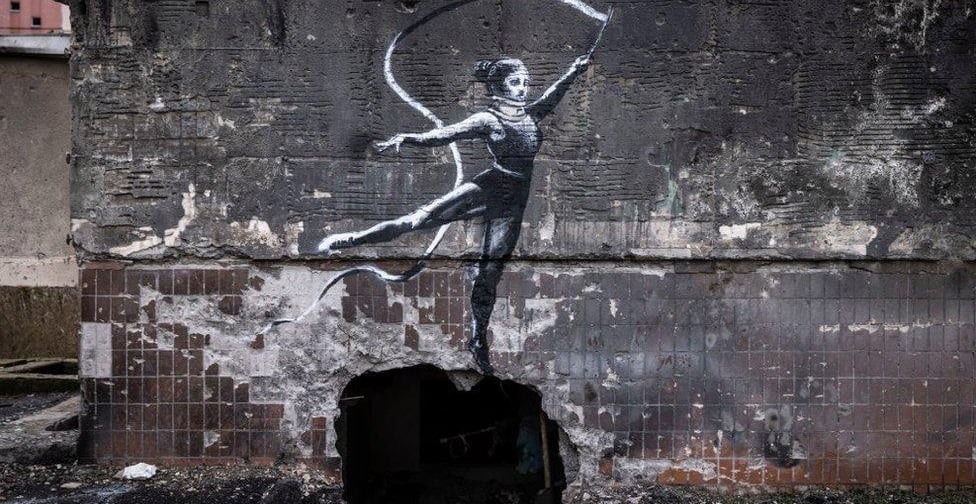
Banksy artwork appears on damaged building in Ukraine.
Learn the official language of Ukraine in 30 days thanks to the most complete grammar, vocabulary and culture course available.
Start speaking Ukrainian today!


For requests or suggestions: pr@learnukrainian.org
© 2026 Ukraine
Support Ukraine in its fight for Freedom: